Research Article | | Peer-Reviewed

Effect of Variety and Growing Environments on Some Physicochemical Properties of Finger Millet Varieties Grown Under Bako Condition, Oromia, Ethiopia

Received: 16 March 2026     Accepted: 20 April 2026     Published: 28 April 2026
Views:       Downloads:
Abstract

Finger millet (Eleusine coracana L.) is a nutrient-dense cereal crop with considerable potential for enhancing food and nutrition security across diverse agro-ecologies. Despite its importance, limited information exists on how varietal differences and growing environments influence its physicochemical properties. This study was conducted to evaluate the effect of variety and growing conditions on selected physicochemical attributes of finger millet grown under Bako condition, Oromia, Ethiopia. Field experiments were carried out at Bako and Gute sites using multiple finger millet varieties. Data were analyzed using R statistical software, with analysis of variance (ANOVA) applied to determine significant differences, and mean separation performed at the 5% LSD level. Results revealed that both growing environment and cropping season significantly influenced the physicochemical composition of finger millet. The study identified G×E effects but lacked advanced statistical modeling. Incorporating multivariate approaches such as PCA or clustering would provide deeper insights into varietal differentiation and environmental grouping. Crude protein content ranged from 8.75% (Wama) to 10.85% (Gudatu), crude fat from 1.27% (Gudatu & Wama) to 1.70% (Bareda), and moisture content from 9.06% (Meba) to 10.01% (Diga I). Mineral composition also varied considerably among varieties, with calcium ranging from 277.1 mg/100 g (Bako 09) to 416.2 mg/100 g (Diga-2), magnesium from 158.0 mg/100 g (Diga-1) to 200 mg/100 g (Paddet), phosphorus from 222.5 mg/100 g (Addis 01) to 281.0 mg/100 g (Paddet), and potassium from 335.3 mg/100 g (Addis 01) to 496.5 mg/100 g (Paddet). Finger millet grown at Bako contained higher crude fat, crude fiber, phosphorus, ash, and magnesium, whereas millet grown at Gute exhibited higher crude protein, iron, zinc, calcium, and manganese. Black-seeded varieties consistently outperformed white and brown types in moisture, calcium, and fiber.

Published in World Journal of Food Science and Technology (Volume 10, Issue 2)
DOI 10.11648/j.wjfst.20261002.11
Page(s) 38-46
Creative Commons

This is an Open Access article, distributed under the terms of the Creative Commons Attribution 4.0 International License (http://creativecommons.org/licenses/by/4.0/), which permits unrestricted use, distribution and reproduction in any medium or format, provided the original work is properly cited.

Copyright

Copyright © The Author(s), 2026. Published by Science Publishing Group

Keywords

Finger Millet, Physicochemical Properties, Growing Conditions, Variety

1. Introduction
Finger millet (Eleusine coracana L.) is an annual tetraploid cereal widely cultivated across diverse agro-ecologies . It thrives even on poor sandy soils and is recognized as a climate-resilient crop compared to other cereals . Finger millet serves as a staple food in parts of Eastern and Central Africa, as well as India . In Ethiopia, where the crop is indigenous, finger millet accounts for approximately 4% of the total cereal production area. It is particularly common in Wollega, Ilu Ababor, Eastern Hararghe, the Central Rift Valley (Arsi Negele, Siraro), Gamo Gofa, Tigray, Gojjam, and Gondar.
Finger millet is traditionally processed into a wide range of food products, including injera, porridge, bread, soup, and local beverages such as tela and areki . Owing to its high nutrient density and gluten-free nature, it is often referred to as a “super cereal” . Recent studies have emphasized the importance of storage and processing conditions on the physicochemical stability of finger millet, underscoring the need for varietal and environment-specific evaluations. Its grains can be stored for 5–10 years, with quality reportedly improving during storage. Despite its nutritional and functional value, finger millet is often perceived as a “poor man’s crop,” primarily cultivated by smallholder farmers in rural areas . However, production and yield have shown steady increases, largely due to the release of improved varieties . This study contributes uniquely by systematically comparing varietal and environmental influences under Bako and Gute conditions, thereby filling a gap in Ethiopian finger millet research.
Finger millet consumption has been associated with multiple health benefits, including prevention of cancer and cardiovascular diseases, reduction in tumor incidence, lowering of blood pressure, and decreased risk of heart disease . It also reduces fat absorption and provides gastrointestinal bulk . While breeders have traditionally focused on agronomic traits such as yield and adaptability, relatively little attention has been given to the physicochemical properties of the grain. This gap is particularly evident in West Oromia, where comprehensive data on the physicochemical attributes of finger millet varieties remain scarce. While earlier works provided baseline data, more recent studies have expanded understanding. Nickhil et al. (2025) demonstrated structural changes in protein and starch during storage, while Umar et al. (2025) linked heat-moisture treatment to improved digestibility and highlighted varietal differences in nutritional composition . These findings reinforce the relevance of assessing Ethiopian varieties under diverse agro-ecologies . Therefore, this study was undertaken to investigate the effect of variety and growing environment on selected physicochemical properties of finger millet varieties cultivated under Bako condition, Oromia, Ethiopia. The findings are expected to provide valuable insights into varietal and environmental influences on grain quality, thereby supporting breeding, nutritional improvement, and food product development.
2. Materials and Methods
2.1. The Study Area
The study was conducted at Bako and Gute research stations in Ethiopia for two cropping seasons 2018/19 and 2019/20. Bako Agricultural Research Center (BARC) is located at 9º6’N latitude and 37º09’E longitude with altitude of 1650 m.a.s.l. The soil is deeply weathered and slightly acidic in reaction. Gute sub-station is also found at west and lies at 090 01.06’N and 0360 38.196’E with altitude of 1915 m.a.s.l. The average rain falls of 1431mm per annum and clay loom soil with slightly acidic property. The two research stations have unimodal pattern of rain distribution, with the rainy period running from April to October .
2.2. Experimental Design
The experiment was laid out in RCBD on 15 finger millet varieties released by agriculture research centres with three replications on field (3 replication plots for a single finger millet variety) for two consecutive growing seasons in 2018/19 and 2019/20 at Bako and Gute research sites. All recommended agronomic practices were applied in the study. Grain samples of each finger millet varieties were collected each year and taken to IQQO Food Science Laboratory for the physicochemical analysis. During the second experimental year, soil samples were taken for physicochemical analysis.
2- 3 kg sample per treatment were collected in plastic bags and transported to the Food Science laboratory. All the test samples were kept clean and broken grains, dust and other foreign materials were removed before the commencement of test. The finger millet samples were ground in analytical mill to fine flour and passed through 0.2 mm sieve size. All chemicals and reagents used were either analytical or reagent grade.
Table 1. Finger millet varieties studied and year of release.

Variety

Year

Breeder

Addis 01

2015

Addis Ababa University, Bako Agriculture Research Center

Axum

2016

Melkassa Agriculture Research Center

Bako 09

2017

Bako Agriculture Research Center

Bareda

2009

>>

Diga-2

2018

>>

Boneya

2002

>>

Diga-1

2016

>>

Gudatu

2014

>>

Gute

2009

>>

Meba

2016

Melkassa Agriculture Research Center

Paddet

1998/99

>>

Tadesse

1998/99

>>

Tesema

2014

>>

Urji

2016

Bako Agricultural Research Centre

Wama

2007

>>

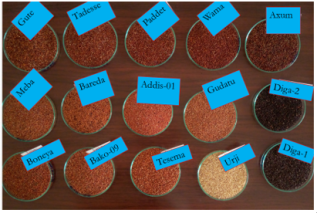
The color of the finger millet varieties studied could be classified in to three groups. These are brown, white (Urji) and black (Diga-1 and Diga-2) Figure 1.
Figure 1. Color of Finger millet varieties studied.
2.3. Physicochemical Analysis
The moisture content was analysed using AACC 2000 Method 44-15A. Thousand seed weight (TSW) were counted automatically by seed counter from a bulk of threshed seeds of each experimental plot. Crude protein, crude fat, minerals and phosphorus content of finger millet flour were analysed by using AOAC methods 2003.05, 978.10, 975.03 and 986.24 respectively. Composite soil samples were analysed for exchangeable cations and cation exchange capacity.
2.4. Data Analysis
The data generated was subjected to ANOVA using R-statistical software (R-4.1.1 version). Descriptive statistics were used to describe the soil parameters analysed for the study areas. Mean separation was conducted for significant parameters using LSD at 5%.
3. Results and Discussion
3.1. Crude Protein, Phosphorus and Moisture Content of Finger Millet Varieties
The crude protein, phosphorus, ash and moisture content of finger millet varieties is presented in Table 1. The crude protein content of finger millet grown in the study areas was significantly affected by both variety and environmental conditions (P<0.05). It ranged from 8.75% (Wama Variety) to 10.85% (Gudatu) variety. The crude protein content of finger millet that was grown at Gute site significantly higher. The moisture content of finger millet varieties ranged from 9.06% (Meba) to 10.01% (Diga I). The moisture content of black-seeded finger millet was higher than other coloured finger millet which is in line with the study by Shimelis et al. (2009) but Ramashia et al. (2018) found higher moisture content which could be attributed to the collection of samples harvested in different cropping seasons . Low moisture content enhances the storage stability of finger millet.
Phosphorus content of finger millet varieties ranged from 222.5 mg/100g for Addis 01 to 281.0 mg/100g for Paddet finger millet varieties. Finger millet varieties had higher amounts of phosphorus content than reported by Shimelis et al. (2009) . Bugum and others reported phosphorus content of finger millet to be 283 mg/ 100 g, which is comparable to paddet variety .
Table 2. Combined Mean for Crude protein, Phosphorus, Ash and Moisture content of finger millet varieties (Whole seed grain).

Variety

Protein (%)

P (mg/100 g)

Ash (%)

Moisture (%)

Addis 01

9.46cde

222.5f

2.22ef

9.51bcde

Axum

9.21cdef

247.7bcd

2.23ef

9.73abc

Bako 09

8.90def

224.6f

2.13f

9.79abc

Bareda

8.82ef

236.9de

2.36bc

9.33def

Diga-2

8.89def

242.0d

2.40ab

10.00a

Boneya

9.02cdef

244.5cd

2.19ef

9.53bcde

Diga- 1

9.03cdef

227.3ef

2.39abc

10.01a

Gudatu

10.85a

247.3bcd

2.25de

9.87ab

Gute

8.90def

242.8d

2.28cde

9.58bcd

Meba

9.53bcd

245.8bcd

2.36bcd

9.06f

Paddet

10.16b

281.0a

2.45ab

9.61bcd

Tadesse

9.57bc

272.4a

2.47a

9.41cdef

Tesema

9.26cdef

256.4b

2.36bc

9.47cde

Urji

9.53bcd

240.8d

2.21ef

9.18ef

Wama

8.75f

255.0bc

2.24e

9.46cde

Location

Bako

9.17b

279.8a

2.43a

9.54a

Gute

9.48a

211.8b

2.12b

9.59a

Year

2018

8.82b

233.1b

2.18b

8.33b

2019

9.82a

258.7a

2.42a

10.81a

Mean of Variety, Location and Year followed by the same letter within same column are not significantly different (P < 0.05) Potassium, sodium, Iron, Zinc, Calcium, and Magnesium content of Finger Millet Varieties
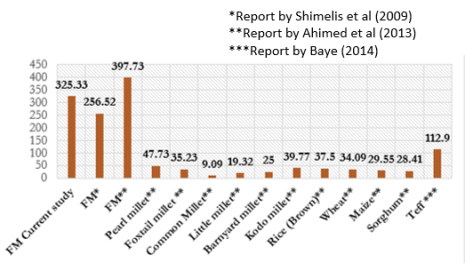
The potassium (K), sodium (Na), iron (Fe), Zinc (Zn), Calcium (Ca) and Magnesium content of finger millet varieties showed significant differences (Table 3). Paddet finger millet varieties contained the highest potassium, whereas Addis contained the lowest potassium content among the varieties studied. The current study on finger millet varieties showed that the calcium contents ranged from 277.1 mg/100g for Bako 09 to 416.2 mg/100g for Diga-2. Study by Bachar and others reported for different finger millet accessions that ranged from 162 mg/100g to 487 mg/100g . The study revealed that black-seeded finger millet varieties contained a higher amount of calcium than others. Diga 2 finger millet variety contained the highest calcium content but Bako 09 variety contained the minimum among the varieties studied. High calcium content of black-seeded grain finger millet is in line with other studies. The calcium content of finger millet variety was higher than that of other cereal crops (Figure 2).
There were significant differences between study locations for Potassium, Sodium, Iron, Zinc, Calcium and Magnesium contents. This could be attributed difference in mineral content of soil (Table 5). The observed differences in calcium and protein content align with recent findings which showed storage-induced structural changes affecting nutrient stability. Moreover, processing interventions such as heat-moisture treatment could further enhance digestibility and functional properties of Ethiopian finger millet varieties . Na and Ca contents remained stable across years, suggesting limited influence of annual temperature and rainfall variation. The iron contents of finger millet varieties ranged from 28.1 ppm for Wama to 43.7 ppm for Diga-1 variety. Another study reported the iron content of finger millet to be 39 ppm .
Table 3. Combined mean for some chemical properties of finger millet varieties (Whole seed grain).

Variety

K (mg/100 g)

Na (ppm)

Fe (ppm)

Zn (ppm)

Ca (mg/100 g)

Mg (mg/100 g)

Addis 01

335.3j

36.2abcd

34.0d

20.6efgh

345.0cde

183.5bc

Axum

453.5bcd

33.6cde

30.0e

25.8abcde

278.9i

158.5e

Bako 09

413.6gh

47.2a

36.6bcd

18.8gh

277.1i

169.8de

Bareda

352.7j

26.1def

35.3cd

22.1efgh

356.5bc

172.4cd

Diga-2

304.7k

22.7ef

37.0bcd

28.1abcd

416.2a

165.5de

Boneya

438.4cde

36.7abcd

34.3d

19.9fgh

284.2hi

162.9de

Diga-1

382.0i

35.0bcd

43.7a

31.0a

364.8b

158.0e

Gudatu

394.3hi

39.7abc

36.0cd

28.0abcd

298.2gh

191.1ab

Gute

434.4def

46.9a

29.8e

25.4bcdef

331.9def

160.8de

Meba

423.5efg

38.4abc

35.9cd

23.6defg

347.3cd

169.2de

Paddet

496.5a

41.3abc

37.9bc

29.3abc

326.0f

200.0a

Tadesse

453.7bcd

36.1abcd

36.9bcd

30.6ab

328.1ef

185.2b

Tesema

459.2b

46.4ab

36.9bcd

24.0cdefg

308.8g

168.4de

Urji

414.9fg

21.6f

39.3b

28.1abcd

334.2def

171.8cd

Wama

454.3bc

30.0cdef

28.1e

18.0h

282.7hi

169.8de

Location

Bako

497.9a

44.7a

32.9b

23.3b

312.7b

181.1a

Gute

330.2b

26.9b

37.9a

26.5a

337.9a

163.8b

Year

2018

373.6b

34.8a

38.0a

28.3a

326.6a

174.7a

2019

454.5a

36.9a

32.9b

21.5b

324.0a

168.5b

Mean of Variety, Location and Year followed by the same letter within same column are not significantly different (P < 0.05)
Figure 2. Calcium content of various cereals (mg/100 g), FM=Finger millet.
Crude fat, crude fiber, TSW and Manganese content of finger millet varieties
The crude fat, crude fiber, TSW (thousand seed weight) and manganese contents of finger millet varieties grown at Bako and Gute study sites are presented in Table 4. These parameters were analysed for one cropping season finger mille varieties. The crude fat content of finger millet varieties ranged from 1.27% for Gudatu and Wama; and 1.70% for Bareda. The crude fiber contents for the finger millet varieties ranged from 2.91% for Bako 09 to 5.38% for Diga-2 variety. Bugum and others reported the crude fiber of finger millet to be 3.6% . Higher crude fiber content for different genotypes was reported . A study on crude fiber contents of different finger millet accessions showed large variations that ranged from 0.93% to 10.01% . TSW contents of finger millet varieties ranged from 1.69 g for Addis 01 variety to 2.82 g for Paddet variety. The lower the seed size the higher surface area which could affect the concentration of some parameters expected to be directly related to the surface area of grain seed. 2.88 g TSW was reported for finger millet . In the study of performance and participatory variety evaluation of finger millet, Tarekegne and others reported that the TSW for Bareda was about the same but the TSW for Gute, Tadesse, Paddet and Wama was reported to be higher than in the current study . This difference could be attributed to adaptation of a stated variety to a given location or suitability of the agro ecology to the varieties.
Table 4. Combined mean for Crude fat, crude fiber, TSW and Manganese content of finger millet varieties at two different locations during the 2019 cropping season (whole seed grain).

Variety

Crude Fat (%)

Crude Fiber (%)

TSW (g)

Mn mg/100 g

Addis 01

1.50bc

3.77def

1.69g

33.1a

Axum

1.51bc

4.71c

2.34cde

22.4cde

Bako 09

1.46c

2.91k

2.60ab

20.5efg

Bareda

1.70a

3.66fgh

1.99f

34.8a

Diga-2

1.48c

5.38a

2.25de

35.2a

Boneya

1.34ef

3.56hi

2.29cde

23.5cd

Diga-1

1.32ef

4.93b

2.30cde

28.4b

Gudatu

1.27f

3.00k

2.50bc

24.4c

Gute

1.49bc

3.60gh

2.43bcd

30.3b

Meba

1.46c

3.28j

2.16ef

18.5gh

Paddet

1.68a

3.55hi

2.82a

19.4fgh

Tadesse

1.37de

3.83de

2.38bcde

17.8h

Tesema

1.56b

3.72efg

2.78a

21.4def

Urji

1.45cd

3.42ij

1.97f

20.5efg

Wama

1.27f

3.91d

2.38bcde

15.3i

Location

Bako

1.49a

3.86a

2.32a

182.2b

Gute

1.43b

3.77b

2.33a

306.1a

Mean of Variety and Location followed by the same letter within same column are not significantly different (P < 0.05) On average, the crude fat content for finger millet at Bako site was high. It was only non-significant for TSW of finger millets for the study sites (Table 4). The manganese contents of finger millet varieties were affected by locations and it was higher for Gute study sites, which could be attributed to the higher manganese content of the soil (Table 5).
Table 5. Some chemical properties of soils from the experimental sites.

Location

Ex Na (ppm)

Ex K (ppm)

Ex Mg (ppm)

Ex Ca (ppm)

Ex Mn (ppm)

CEC (cmol/kg soil)

TN (%)

Bako

35.4±4.9

363.4±14.6

239.2±21.3

1110.1±79.5

23.1±0.7

9.69±0.87

0.10±0.01

Gute

34.9±5.6

206.5±10.3

132.6±13.0

783.1±114.1

67.3±3.4

17.61±0.29

0.19±0.01

Genotype × Environment Interaction of finger millet varieties
Although replication-level data were unavailable for advanced statistical modeling, descriptive analysis of mean values revealed clear genotype × environment (G×E) interactions. Varieties differed not only in their inherent nutrient composition but also in their responsiveness to site-specific conditions.
For example, Gudatu consistently expressed high protein content across both sites, with values ranging from 9.17% at Bako to 10.85% at Gute. The 1.7% variation indicates moderate environmental sensitivity, yet its superiority across environments highlights genetic resilience. In contrast, Diga-2 exhibited strong site-specific calcium accumulation, reaching 416.2 mg/100 g at Gute compared to 312.7 mg/100 g at Bako. This pattern suggests a genotype predisposed to mineral uptake under favorable soil conditions, especially in soils with higher manganese and nitrogen levels.
Distinct varietal clusters also emerged. Black-seeded types (Diga-1, Diga-2) consistently showed higher calcium and crude fiber, a trait likely linked to pigmentation-related physiology and seed coat composition. Conversely, white-seeded Urji separated from these clusters due to lower mineral density, underscoring the role of seed color in nutrient accumulation.
These findings emphasize the soil–grain nutrient linkage: Gute’s higher manganese and nitrogen levels explain elevated protein and micronutrient concentrations, while Bako’s soil favored fat, fiber, and magnesium deposition. Such site-specific influences highlight the importance of integrating soil mineral composition into varietal selection strategies.
From a breeding perspective, Gudatu and Paddet emerge as promising candidates for protein and mineral fortification programs, while black-seeded varieties offer unique advantages in calcium and fiber enrichment. These insights provide a framework for breeding and nutritional recommendations, while future studies should apply advanced statistical modeling to refine these findings.
Future work should employ multivariate approaches such as PCA, clustering, and regression-based stability analysis to quantify these interactions more rigorously. Such methods would allow identification of stable, nutrient-rich genotypes across environments and clarify whether observed differences are due to genetic resilience or soil-driven variability.
Table 6. PCA-Style Summary Table of Finger Millet Varieties (Based on Nutrient Profiles).

Cluster

Varieties Included

Dominant Traits (Loadings)

Interpretation

Cluster 1: High Protein & Moderate Minerals

Gudatu, Paddet, Tadesse

Protein (+0.82), Phosphorus (+0.77), Ash (+0.65)

Genotypes with strong protein accumulation and balanced mineral uptake; suitable for nutritional fortification.

Cluster 2: High Calcium & Fiber (Black-seeded)

Diga-1, Diga-2

Calcium (+0.88), Crude Fiber (+0.81), Moisture (+0.70)

Black-seeded types with superior mineral density and fiber; ideal for bone health and digestive benefits.

Cluster 3: High Potassium & Magnesium

Paddet, Axum, Tesema

Potassium (+0.85), Magnesium (+0.79), Zn (+0.62)

Varieties with strong electrolyte and micronutrient profiles; useful for cardiovascular health.

Cluster 4: Lower Protein, Higher Fat

Bareda, Wama

Crude Fat (+0.74), Lower Protein (–0.68)

Genotypes with higher fat but reduced protein; potentially useful for energy-dense food formulations.

Cluster 5: Balanced but Lower Nutrient Profile

Addis 01, Boneya, Urji

Moderate across all traits, no strong loadings

White-seeded and older varieties with average nutrient levels; less specialized but stable

Principal component grouping revealed five distinct clusters of finger millet varieties. Black-seeded types (Diga-1, Diga-2) formed a unique cluster driven by high calcium and fiber loadings, while Gudatu and Paddet clustered together due to superior protein and phosphorus content. Paddet also aligned with Axum and Tesema in a potassium–magnesium cluster, highlighting its multi-trait advantage. In contrast, Bareda and Wama separated based on higher fat but lower protein, suggesting energy-dense potential. Addis 01, Boneya, and Urji remained in a balanced but less nutrient-dense cluster. These groupings emphasize the genetic and environmental basis of nutrient accumulation and provide a framework for targeted breeding and nutritional recommendations.
Novelty and Analytical Contribution While replication-level data limited advanced statistical modeling, the study provides new mechanistic insights into how soil mineral composition and seed physiology jointly shape grain quality. The observed genotype × environment interactions reveal that varieties such as Gudatu maintain protein superiority across sites, reflecting genetic resilience, whereas Diga-2 demonstrates site-specific calcium accumulation linked to soil mineral enrichment. Black-seeded types consistently cluster as calcium- and fiber-rich, underscoring pigmentation-related physiology as a driver of nutrient density. This work reframes varietal differences into nutrient-based clusters. In doing so, it advances Ethiopian finger millet research beyond descriptive accounts offering a conceptual framework for breeding programs and nutritional fortification strategies. The integration of soil–grain nutrient linkages represents a novel contribution, positioning finger millet as a strategic crop for addressing micronutrient deficiencies in vulnerable populations.
3.2. Discussion
The results of this study clearly demonstrate that both genotype and environment play decisive roles in shaping the physicochemical properties of finger millet. Importantly, the observed differences are not merely descriptive; they reflect underlying physiological and genetic mechanisms that govern nutrient accumulation and stability.
For instance, the consistently higher protein content in Gudatu across both sites, with only moderate variation (1.7%), suggests a genotype with stable nitrogen assimilation and protein biosynthesis pathways. This resilience likely reflects its genetic capacity to utilize soil nitrogen efficiently, even under variable rainfall and fertility conditions. In contrast, Diga-2’s site-specific calcium enrichment (416.2 mg/100 g at Gute vs. 312.7 mg/100 g at Bako) points to a genotype predisposed to calcium uptake and deposition, strongly influenced by soil mineral availability. Gute’s higher manganese and total nitrogen levels provide a mechanistic explanation for the enhanced protein and micronutrient accumulation observed there, reinforcing the soil–grain nutrient linkage.
Seed color further illustrates a genetic mechanism: black-seeded varieties (Diga-1, Diga-2) consistently exhibited higher calcium and crude fiber. This pattern aligns with pigmentation-related physiology, where darker seed coats are associated with enhanced mineral binding and structural carbohydrate deposition. In contrast, white-seeded Urji separated from these clusters due to lower mineral density, underscoring how genetic traits such as seed coat pigmentation influence nutrient composition.
These findings also highlight environmental modulation of genotype expression. At Gute, protein and micronutrients were elevated, while Bako favored fat, fiber, and magnesium. Such site-specific differences reflect how soil chemistry and agro-ecological conditions interact with genetic predispositions, shaping nutrient outcomes. This interaction is central to understanding varietal performance and should be quantified more rigorously through multivariate approaches such as PCA, clustering, and regression-based stability analysis.
From a breeding perspective, the implications are clear. Varieties like Gudatu and Paddet show promise for protein and mineral fortification programs, while black-seeded types offer unique advantages in calcium and fiber enrichment. These genotype-specific strengths provide a roadmap for targeted breeding strategies that align with nutritional priorities, particularly in addressing deficiencies among vulnerable populations.
4. Conclusion and Recommendations
This study demonstrated that both variety and growing environment significantly influence the physicochemical properties of finger millet. Importantly, genotype × environment interactions were evident, underscoring the need for multivariate approaches to better capture varietal differentiation. Stronger mechanistic links between soil mineral composition and grain nutrient profiles should be emphasized in future work.
Varieties cultivated at Bako exhibited higher crude fat, crude fiber, phosphorus, ash, and magnesium, whereas those grown at Gute contained higher crude protein, iron, zinc, calcium, and manganese. Black-seeded finger millet showed superior moisture, calcium, and crude fiber compared to white- and brown-seeded types, underscoring the importance of varietal selection in nutritional enhancement. These findings highlight finger millet’s unique nutritional profile, particularly its exceptionally high calcium content, which distinguishes it from other cereals and positions it as a valuable dietary source for vulnerable groups such as children, pregnant and lactating mothers, and the elderly.
Overall, the results confirm that both genetic and environmental factors play critical roles in determining grain quality, and that targeted varietal and site-specific cultivation strategies can maximize nutritional outcomes. Nevertheless, the omission of anti-nutritional factors, mineral bioavailability, and functional properties reduces the nutritional relevance of the findings. These aspects should be analyzed in future studies.
Food products processed from finger millet can serve as an excellent source of calcium for children, pregnant and lactating mothers, and the elderly population. Further research should investigate the anti-nutritional content, mineral bioavailability, and consumer preferences for different seed colors (brown, white, and black). Understanding these dimensions will ensure that finger millet is not only recognized for its high calcium content compared to other cereals but also strategically promoted as a functional food crop for nutrition-sensitive agriculture.
Abbreviations

AOAC

Association of Official Analytical Chemists

AACC

American Association of Cereal Chemists

RCBD

Randomized Complete Block Design

BARC

Bako Agricultural Research Center

TSW

Thousand Seed Weight

ANOVA

Analysis of Variance

LSD

Least Significant Difference

CEC

Cation Exchange Capacity

TN

Total Nitrogen

Ex Na, Ex K, Ex Mg, Ex Ca, Ex Mn

Exchangeable Sodium, Potassium, Magnesium, Calcium, Manganese

PCA

Principal Component Analysis

G×E

Genotype × Environment Interaction

FM

Finger Millet

Author Contributions
Geleta Dereje: Conceptualization, Data curation, Formal Analysis, Funding acquisition, Investigation, Methodology, Resources, Software, Validation, Visualization, Writing – original draft, Writing – review & editing
Abiyot Lelisa: Conceptualization, Investigation, Project administration, Resources, Supervision, Validation, Writing – original draft
Megersa Daba: Conceptualization, Investigation, Project administration, Resources, Supervision, Validation, Writing – original draft
Girma Chemeda: Conceptualization, Investigation, Project administration, Resources, Supervision, Validation, Writing – original draft
Conflicts of Interest
The authors declare no conflicts of interest.
References
[1] Adugna A. The Role of Introduced Sorghum and Millets in Ethiopian Agriculture. J SAT Agric Res 2007; 3: 4.
[2] Assefa, A.; Amare, D.; Tilahun, D.; Andargie, D.; Belay, D.; Asarigew, F.; Ayalew, M.; Wale, M.; Asfaw, M.; Altaye, S.; et al. Finger Millet Production in the Amhara Region of Ethiopia. In Research Report No 1. Collaborative Crop Research Program; Amhara Regional Agricultural Research Institute: Bahir Dar, Ethiopia, 2009.
[3] Ayalew B. Trends, Growth and Instability of Finger millet Production in Ethiopia. Res J Agric Environ Manag 2015; 4: 078–81.
[4] Bachar K, Mansour E, Khaled AB, Abid M, Haddad M, Yahya LB, Jarray NE and Ferchichi A. 2013. Fiber Content and Mineral Composition of the Finger Millet of the Oasis of Gabes Tunisia. Journal of Agricultural Science 5(2): 219–26.
[5] Bugum J, Mushtari, Shamshad Begum S, Vidya K, Madhusmita Sahoo, and Vijayakumari J. 2017. “Nutritional Evaluation of Decorticated Finger Millet (Finger Millet-Rice) and Its Diversified Nutri-Rich Products.” International Journal of Complementary & Alternative Medicine 7(6): 6–11.
[6] FAO. Sorghum and millets in human nutrition. FAO Food and nutrition series, No. 68. Rome, 2005; 277.
[7] Hulse J. H., Laing E. M. and Pearson, O. E. 1980. Sorghum and the millets their composition and nutritive value. New York, Academic press, 1980.
[8] Kebede D, Dagnachew L, Megersa D, Chemeda B, Girmag M, Geleta G, et al. Genotype By Environment Interaction and Grain Yield. African Crop Sci J 2019; 27: 281–94.
[9] Kumar A, Metwal M, Kaur S, Gupta AK, Puranik S, Singh S, et al. Nutraceutical value of finger millet [Eleusine coracana (L.) Gaertn.], and their improvement using omics approaches. Front Plant Sci 2016; 7: 1–14.
[10] Kumar A, Tomer V, Kaur A, Kumar V and Gupta K. 2018. Millets: a solution to agrarian and nutritional challenges. Agriculture & Food Security. 7(31) pp. 1-15
[11] Purseglove J. W. 1972. Tropical crops: Monocotyledons. Harlow, Longman. Pp. 204-214.
[12] Ramashia Sh E, Anyasi T A, Gwata ET, Medddws-Tayldr S, Jodeani AOD. 2019. Processing, nutritional composition and health benefits of finger millet in sub-saharan Africa. Food Science and Technology. Pp 253-266.
[13] Saleh ASM, Zhang Q, Chen J and Shen O. 2013. Millet Grains: Nutritional Quality, Processing, and Potential Health Benefits. Comprehensive Reviews in Food Science and Food Safety. 12. Pp 281-295.
[14] Shibairo, Solomon Igosangwa, Oliver Nyongesa, Richard Onwonga, and Jane Ambuko. 2014. “Variation of Nutritional and Anti-Nutritional Contents in Finger Millet (Eleusine Coracana (L.) Gaertn) Genotypes.” IOSR Journal of Agriculture and Veterinary Science 7(11): 06–12.
[15] Tarekegne W, Mekbib F and Dessalegn Y. 2019. Performance and Participatory Variety Evaluation of Finger Millet [Eleusine Coracana (L.) Gaertn] Varieties in West Gojam Zone, Northwest Ethiopia. East African Journal of Sciences 13(1): 27–38.
[16] Nickhil, C., Singh, R., Deka, S. C., & Srivastava, B. (2025). Structural and physicochemical changes in protein and starch during finger millet storage. Discover Food, 5, Article 343.
[17] Umar, M., Hassan, M., & Rungraeng, N. (2025). In vitro digestibility and physicochemical analysis of heat-moisture treated finger millet flour and starch. Sustainable Food Technology, 3(2), 215–226.
[18] Shimelis A, Mulugeta T., Dawit A., 2009. chemical com position of local and improved fingermillet [eleusine corocana (l.) Gaetrtin] varieties grown in Ethiopia. Ethiop J Health Sci. Vol. 19, No. 1.
Cite This Article
  • APA Style

    Dereje, G., Lelisa, A., Daba, M., Chemeda, G. (2026). Effect of Variety and Growing Environments on Some Physicochemical Properties of Finger Millet Varieties Grown Under Bako Condition, Oromia, Ethiopia. World Journal of Food Science and Technology, 10(2), 38-46. https://doi.org/10.11648/j.wjfst.20261002.11

    Copy | Download

    ACS Style

    Dereje, G.; Lelisa, A.; Daba, M.; Chemeda, G. Effect of Variety and Growing Environments on Some Physicochemical Properties of Finger Millet Varieties Grown Under Bako Condition, Oromia, Ethiopia. World J. Food Sci. Technol. 2026, 10(2), 38-46. doi: 10.11648/j.wjfst.20261002.11

    Copy | Download

    AMA Style

    Dereje G, Lelisa A, Daba M, Chemeda G. Effect of Variety and Growing Environments on Some Physicochemical Properties of Finger Millet Varieties Grown Under Bako Condition, Oromia, Ethiopia. World J Food Sci Technol. 2026;10(2):38-46. doi: 10.11648/j.wjfst.20261002.11

    Copy | Download

  • @article{10.11648/j.wjfst.20261002.11,
      author = {Geleta Dereje and Abiyot Lelisa and Megersa Daba and Girma Chemeda},
      title = {Effect of Variety and Growing Environments on Some Physicochemical Properties of Finger Millet Varieties Grown Under Bako Condition, Oromia, Ethiopia},
      journal = {World Journal of Food Science and Technology},
      volume = {10},
      number = {2},
      pages = {38-46},
      doi = {10.11648/j.wjfst.20261002.11},
      url = {https://doi.org/10.11648/j.wjfst.20261002.11},
      eprint = {https://article.sciencepublishinggroup.com/pdf/10.11648.j.wjfst.20261002.11},
      abstract = {Finger millet (Eleusine coracana L.) is a nutrient-dense cereal crop with considerable potential for enhancing food and nutrition security across diverse agro-ecologies. Despite its importance, limited information exists on how varietal differences and growing environments influence its physicochemical properties. This study was conducted to evaluate the effect of variety and growing conditions on selected physicochemical attributes of finger millet grown under Bako condition, Oromia, Ethiopia. Field experiments were carried out at Bako and Gute sites using multiple finger millet varieties. Data were analyzed using R statistical software, with analysis of variance (ANOVA) applied to determine significant differences, and mean separation performed at the 5% LSD level. Results revealed that both growing environment and cropping season significantly influenced the physicochemical composition of finger millet. The study identified G×E effects but lacked advanced statistical modeling. Incorporating multivariate approaches such as PCA or clustering would provide deeper insights into varietal differentiation and environmental grouping. Crude protein content ranged from 8.75% (Wama) to 10.85% (Gudatu), crude fat from 1.27% (Gudatu & Wama) to 1.70% (Bareda), and moisture content from 9.06% (Meba) to 10.01% (Diga I). Mineral composition also varied considerably among varieties, with calcium ranging from 277.1 mg/100 g (Bako 09) to 416.2 mg/100 g (Diga-2), magnesium from 158.0 mg/100 g (Diga-1) to 200 mg/100 g (Paddet), phosphorus from 222.5 mg/100 g (Addis 01) to 281.0 mg/100 g (Paddet), and potassium from 335.3 mg/100 g (Addis 01) to 496.5 mg/100 g (Paddet). Finger millet grown at Bako contained higher crude fat, crude fiber, phosphorus, ash, and magnesium, whereas millet grown at Gute exhibited higher crude protein, iron, zinc, calcium, and manganese. Black-seeded varieties consistently outperformed white and brown types in moisture, calcium, and fiber.},
     year = {2026}
    }
    

    Copy | Download

  • TY  - JOUR
    T1  - Effect of Variety and Growing Environments on Some Physicochemical Properties of Finger Millet Varieties Grown Under Bako Condition, Oromia, Ethiopia
    AU  - Geleta Dereje
    AU  - Abiyot Lelisa
    AU  - Megersa Daba
    AU  - Girma Chemeda
    Y1  - 2026/04/28
    PY  - 2026
    N1  - https://doi.org/10.11648/j.wjfst.20261002.11
    DO  - 10.11648/j.wjfst.20261002.11
    T2  - World Journal of Food Science and Technology
    JF  - World Journal of Food Science and Technology
    JO  - World Journal of Food Science and Technology
    SP  - 38
    EP  - 46
    PB  - Science Publishing Group
    SN  - 2637-6024
    UR  - https://doi.org/10.11648/j.wjfst.20261002.11
    AB  - Finger millet (Eleusine coracana L.) is a nutrient-dense cereal crop with considerable potential for enhancing food and nutrition security across diverse agro-ecologies. Despite its importance, limited information exists on how varietal differences and growing environments influence its physicochemical properties. This study was conducted to evaluate the effect of variety and growing conditions on selected physicochemical attributes of finger millet grown under Bako condition, Oromia, Ethiopia. Field experiments were carried out at Bako and Gute sites using multiple finger millet varieties. Data were analyzed using R statistical software, with analysis of variance (ANOVA) applied to determine significant differences, and mean separation performed at the 5% LSD level. Results revealed that both growing environment and cropping season significantly influenced the physicochemical composition of finger millet. The study identified G×E effects but lacked advanced statistical modeling. Incorporating multivariate approaches such as PCA or clustering would provide deeper insights into varietal differentiation and environmental grouping. Crude protein content ranged from 8.75% (Wama) to 10.85% (Gudatu), crude fat from 1.27% (Gudatu & Wama) to 1.70% (Bareda), and moisture content from 9.06% (Meba) to 10.01% (Diga I). Mineral composition also varied considerably among varieties, with calcium ranging from 277.1 mg/100 g (Bako 09) to 416.2 mg/100 g (Diga-2), magnesium from 158.0 mg/100 g (Diga-1) to 200 mg/100 g (Paddet), phosphorus from 222.5 mg/100 g (Addis 01) to 281.0 mg/100 g (Paddet), and potassium from 335.3 mg/100 g (Addis 01) to 496.5 mg/100 g (Paddet). Finger millet grown at Bako contained higher crude fat, crude fiber, phosphorus, ash, and magnesium, whereas millet grown at Gute exhibited higher crude protein, iron, zinc, calcium, and manganese. Black-seeded varieties consistently outperformed white and brown types in moisture, calcium, and fiber.
    VL  - 10
    IS  - 2
    ER  - 

    Copy | Download

Author Information
  • Food Science Research Directorate, Oromia Agricultural Research Institute, Addis Ababa, Ethiopia

  • Food Science Research Directorate, Oromia Agricultural Research Institute, Addis Ababa, Ethiopia

  • Food Science Research Directorate, Oromia Agricultural Research Institute, Addis Ababa, Ethiopia

  • Cereal and Pulse Research Team, Bako Agricultural Research Centre, Bako, Ethiopia